
19 June 2026—Juneteenth!
Honoring African American Quakers in the Anti-Slavery & Suffrage Movements
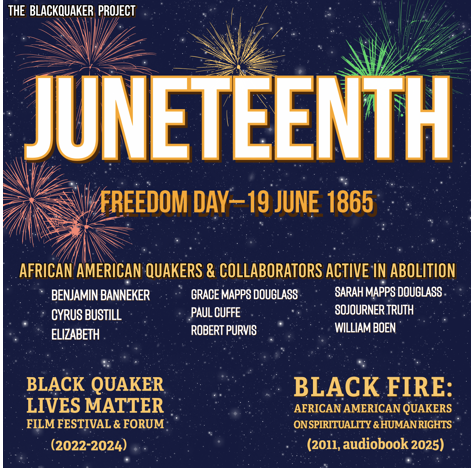
Happy Juneteenth from the BlackQuaker Project!
A national holiday commemorating the end of slavery in the USA, Juneteenth was signed into law by President Joe Biden on 17 June 2021. This gave federal recognition to a tradition of celebration practiced among African Americans since Union troops arrived in Galveston, Texas, on 19 June 1865 to inform enslaved African Americans of their freedom, decreed in Abraham Lincoln’s Emancipation Proclamation of 1 January 1863.
This year our ministry wishes to spotlight the involvement of African American Quakers in the anti-slavery and women’s rights movements. Today we bring to your attention nine trailblazing African American Quaker abolitionists and suffragettes active within the Black liberation struggle during the 18th and 19th centuries. We hope Friends take inspiration from these remarkable life stories as we approach the 2027 Friends World Committee for Consultation’s (FWCC) Global Online Gathering (29 September to 3 October), during which yearly meetings worldwide will reflect on how their local communities have worked to confront historical and contemporary injustice.
AFRICAN AMERICAN QUAKER SEEKER-ACTIVISTS
Benjamin Banneker
(9 November 1731 – 9 October 1806)
Born to a free family of Senegalese descent, Banneker was a largely self-educated mathematician, astronomer, and inventor who was recruited by Friend George Ellicott to survey the boundaries of Washington, D.C. Known for his rigorous almanacs, Banneker used his platform as a prominent African American intellectual to challenge notions of white supremacy by including speeches from leading USA and UK abolitionists in his publications. Most notably, Banneker denounced the hypocrisy of Thomas Jefferson, penning a searing 1791 letter to the Founding Father–then Secretary of State–which critiqued the contradictions between the equality Jefferson wrote of in the Declaration of Independence and the brutal realities of USA chattel slavery.
Cyrus Bustill
(2 February 1732 – 1806)
Cyrus Bustill, formerly enslaved, became a successful baker, businessman, and community leader in Philadelphia. After gaining his freedom, he used his skills as a baker to build a prosperous business and even baked bread for George Washington’s troops as they crossed the Delaware River during the Revolutionary War. Bustill co-founded the Free African Society, which provided assistance to free African Americans and laid the foundation for later Black institutions. Cyrus Bustill is an ancestor of the towering 20th-century African American pan-Africanist, bass-baritone concert and recording artist, stage and screen actor, all-American athlete, and scholar Paul Robeson.
William Boen
(1735 – 1824)
A farmer born into slavery in New Jersey who later gained his freedom, William Boen was one of the earliest African Americans to de-segregate the Religious Society of Friends. His petitions to join the Society were rejected four times before he was able to become a member of Mount Holly Friends Meeting in 1814.
Paul Cuffe
(17 January 1759 – 7 January 1817)
Born to a formerly enslaved father and a Wampanoag mother, Cuffe grew up to be a successful merchant sea captain, owning several ships. As one of the wealthiest free African Americans in the USA, Cuffe built and funded one of the first racially integrated schools in the United States, guaranteed the construction of the Westport (MA) Friends Meetinghouse, and established trade connections between the USA and Sierra Leone, West Africa. Cuffe was a leader in efforts to organize repatriation for enslaved peoples as an escape from chattel slavery in the USA. A fierce critic of early American democratic institutions, Cuffe served jail time during the Revolutionary War for refusing to pay taxes to a country that deprived him and other African Americans of the right to vote.
Elizabeth
(1766-1866)
Born into slavery, Elizabeth, who refused to marry or take a surname, was a regular attender at Quaker meetings who became an itinerant Methodist Minister active throughout the USA and Canada. She was known for giving sermons condemning chattel slavery, would preach to interracial congregations in Baltimore despite institutional opposition to her presence, and even established a school for Black orphans.
Sojourner Truth
(1797 – 26 November 1883)
A legendary abolitionist and women’s rights movement leader, Sojourner Truth was born into slavery in New York as Isabella Baumfree. Escaping to freedom in 1826, she successfully sued for custody of her son, who had been sold to an Alabama slave owner. Sojourner became known as a fierce public orator who traveled the country giving speeches calling for the liberation of African Americans, women, and most especially Black women, whom she argued were routinely excluded from the women’s rights movement. She notably challenged prominent suffragists of her era to recognize the struggles of African American women in her historic, impromptu speech, “Ain’t I a Woman?,” at the 1851 Women’s Convention in Akron, Ohio.
Grace Mapps Douglass
(1782 – 9 March 1842)
A pioneering abolitionist and women’s rights activist, Grace Bustill Douglass was born to Cyrus Bustill and Elizabeth Morey, a Quaker of English descent whose ancestry can be traced back to Friend Humphey Morey, the first Mayor of Philadelphia. Excluded from the all-male Philadelphia Anti-Slavery Society, she became a founding member of the Philadelphia Female Anti-Slavery Society in 1833, working alongside prominent Black and white activists, such as Lucretia Mott and the Grimké sisters, to lobby the federal government to abolish slavery, organize boycotts, and provide aid to the Underground Railroad. Though a descendant of several generations of Quakers stretching back to the Mayflower, Grace and her daughter—Sarah Mapps Douglass—were forced to sit in segregated seating on the back bench of Arch Street Meeting in Philadelphia. Like her father, Grace was an ancestor of the 20th century renaissance man Paul Robeson.
Sarah Mapps Douglass
(9 September 1806 – 8 September 1882)
Following in the footsteps of her mother, Grace Mapps Douglass, Sarah was a trailblazing abolitionist, writer, educator, and activist. A lifelong teacher, she taught at schools throughout Philadelphia where she could support Black students, later founding a private school for African American girls and co-founding the Female Literary Association (1831), one of the earliest literary and social societies for African American women in the country. Later in life, she studied anatomy and health at the Female Medical College of Pennsylvania, becoming one of the first African American women known to receive formal training in medicine. All the while, Douglass published influential writings that addressed issues of race, gender, education, and social reform, helping to shape public discussion of these topics. Like her mother, Grace, and her grandfather, Cyrus Bustill, Sarah is a member of the eminent Bustill-Douglass Quaker family whose descendants include Paul Robeson.
Robert Purvis
(1810-1898)
Robert Purvis was a leading African American abolitionist who worked closely with major anti-slavery activists of his time such as William Loyd Garrison and Lucretia Mott. A key figure in the Pennsylvania chapter of the Underground Railroad, Purvis offered his home near Philadelphia as shelter to hundreds of African Americans escaping slavery. Purvis was not only a founding member of the Philadelphia Anti-Slavery Society but chaired Philadelphia’s General Vigilance Committee which provided aid, medical care, and legal defense to freedom seekers while coordinating the activities of the Underground Railroad in Pennsylvania. While he worked extensively with Quakers in Philadelphia, Purvis remained only a collaborator and not a member of the Society of Friends, possibly due to a refusal to accept non-violence. Though not a Quaker, his children to Quaker schools, and lived across the street from Byberry Friends Meeting with his wife, Friend Tracey Townsend, who renounced her membership in the Society of Friends shortly after their marriage.
FURTHER READING
We hope these innovative resources will aid those seeking truth and justice, and encourage you to write to us at theblackquakerproject@gmail.com with any reflections, insights, or questions you may have.
- Angell, Stephen W. “The Early Period.” Black Fire: African American Quakers on Spirituality and Human Rights, edited by Harold D. Weaver Jr., Paul Kriese, and Stephen W. Angell. Quaker Press of FGC, Philadelphia, 2011, pp. 1–43.
- For further information on the F/friends discussed in today’s e-newsletter–with the exception of Cyrus Bustill and Grace Mapps Douglass–please see our 2011 anthology now available as an 2025 audiobook.
- Gordon-Reed, Annette. ON JUNETEENTH. New York: Liveright Press, 2021.
Peace and Blessings,
The BlackQuaker Project
Wellesley Friends Meeting,
New England Yearly Meeting of Friends (Quakers)
www.theblackquakerproject.org
19 June 2026: Juneteenth!

