
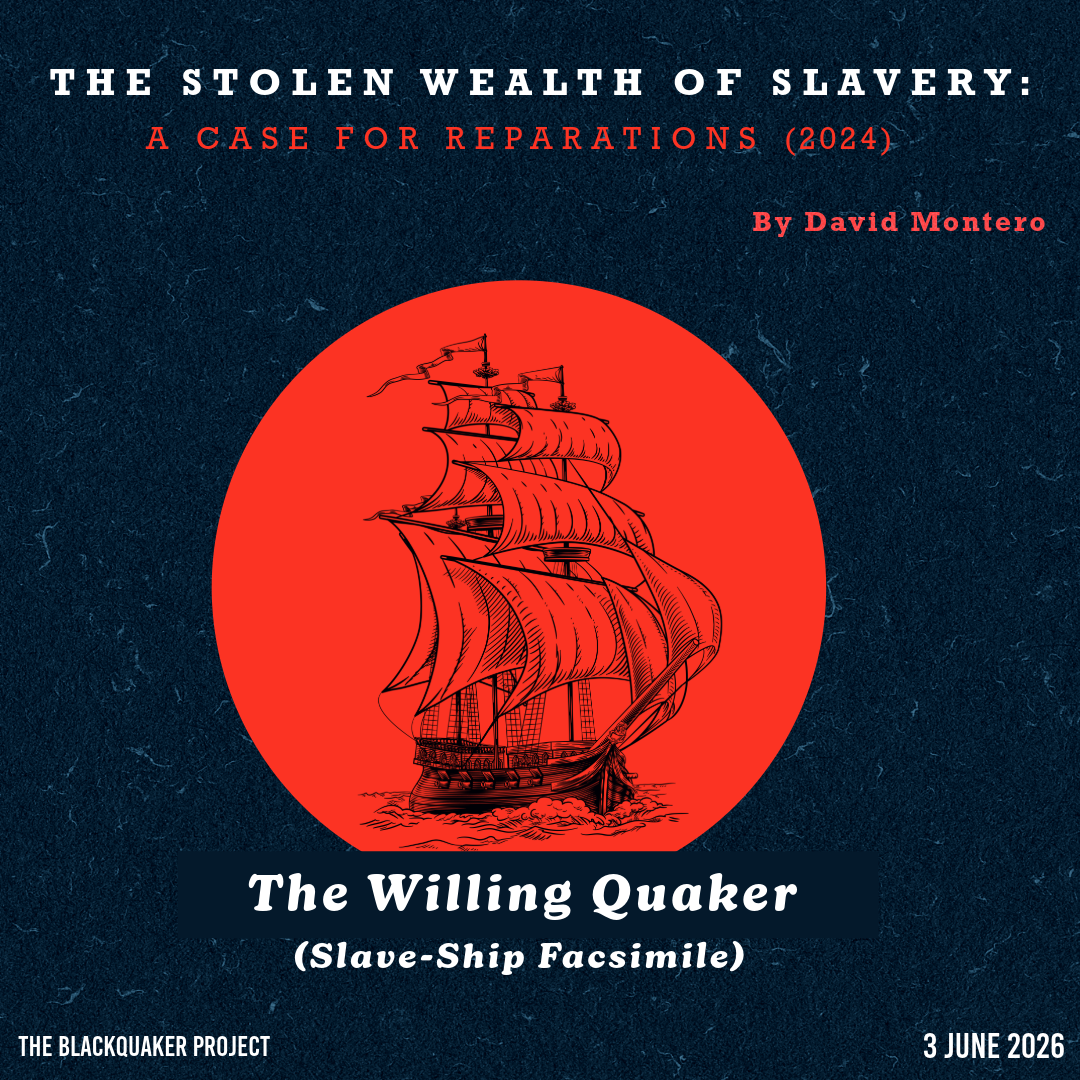
“[Many] of the men most responsible for institutionalizing the cotton triangle at the heart of America’s slave industries…were all Quakers.”
–David Montero, The Stolen Wealth of Slavery: A Case for Reparations (2024)
Happy Pride Month from the BlackQuaker Project (BQP)!
As Juneteenth–celebrated nationally on 19 June–approaches, our ministry wishes to spotlight breakthrough scholarship on the central financial role of Quakers in the trans-Atlantic slave trade and chattel slavery. We will share excerpts from the sobering book that brought these revelations to our attention, re-affirm the importance of Retrospective Justice in addressing past injustice, offer queries for reflection, and share important news from the Friends World Committee for Consultation (FWCC).
The BlackQuaker Project is thoroughly disappointed to learn of the deep, central, and lucrative involvement of northern Quakers–merchants and bankers especially–in the institution and industry of chattel slavery in the Americas. These uncomfortable truths can be found in David Montero’s The Stolen Wealth of Slavery: A Case for Reparations, which uncovers the extent to which economic elites in the North participated in—and profited from—the enslavement of African people.
For nearly 400 years, cash crops and precious metals (such as iron, gold, and silver) produced by enslaved Africans in the Americas flowed into European factories, where they were processed into textiles, rum, and firearms that were shipped to Africa and exchanged for kidnapped Africans, who were then trafficked through the Middle Passage to the Americas, where a lifetime of brutal labor awaited them. This vicious cycle, known as the triangular trade, would not have been possible without North American merchants, who brought ruthless speed and efficiency to the logistics of the slave trade, and bankers, who funded both the trade and Southern plantations–all from which they amassed enormous, generational wealth. Montero reveals an extensive web of aristocratic Northern families who intermarried and profited from slavery even more than their Southern counterparts. Most notable for our ministry is the revelation that Quaker businessmen and Quaker businesses exploited people of African descent mercilessly and hypocritically, playing an integral role in establishing and financing these dehumanizing institutions for generations while, in some cases, claiming to be abolitionists. Today we share select excerpts from this publication, personally chosen for our readership by author David Montero, whose book is now available to purchase from Hatchett Books and Amazon.
Excerpts from The Stolen Wealth of Slavery: A Case for Reparations (2024)
Selected by author David Montero:
QUAKER INVOLVEMENT IN SLAVERY: COTTON SHIPPING, THE BLACK BALL LINE, AND CITIBANK
[Many] of the men most responsible for institutionalizing the cotton triangle at the heart of America’s slave industries—Francis Thompson, Isaac Wright, and Jeremiah Thompson—were all Quakers. In Capitalism and Slavery [1944], Eric Williams observed that “slave dealing was one of the most lucrative investments of English as well as American Quakers, and the name of a slaver [ship], The Willing Quaker,…symbolizes the approval with which the slave trade was regarded in Quaker circles.”
Between 1818 and 1828, Jeremiah Thompson, a Quaker, sold and shipped so much cotton abroad that he was considered the foremost cotton exporter in the United States—referred to by some as the country’s first “cotton king”—as well as the nation’s largest shipowner.
In 1818, [Benjamin] Marshall, together with Francis Thompson, his nephew Jeremiah Thompson, and Isaac Wright, launched a new line of commercial ocean liners. They explained in a letter to one of Liverpool’s leading cotton houses: “These ships shall leave New York, full or not full, on the 5th, and Liverpool on the 1st, of every Month throughout the year.” Regular service, dependable timing, shipping that ran like a machine, something never done before. It constituted nothing less than a revolution in transportation and the business of slavery.
The first of their ships to set sail for Liverpool was called the James Monroe, and its hull was filled mostly with apples, and only seventy-one bales of cotton. But, as advertised, despite the paucity of its cargo, it sailed, nonetheless. Its flag was a red blazon with a black ball at its center. As a result, the first of the regularized transatlantic ocean liners became known as the Black Ball Line. Three other ships followed the James Monroe, each about one hundred feet long and four hundred tons in carrying capacity. All lost money in the beginning, being too capacious, and too empty. But Black Ball’s owners had the capital to wait it out. Success did come, roughly by 1820, and it changed shipping, enslavement, and New York forever. “From the sailing of this packet,” wrote Grant Thorburn in 1845, “we may date the day from whence the commerce of New-York began to increase seven-fold.”
The Black Ball ships were soon loaded up, as the idea of regular cotton shipments caught on, spawning an industry of competitors and imitators—the Red Star Line in 1821, the Blue Swallowtail in 1822, among others—that opened numerous additional lines across the Atlantic, and down the coasts to southern plantations as well. All sides of the cotton triangle began to flow regularly and exponentially.
A “commercial marine” emerged, as the Southern Literary Messenger of Richmond later called it, “which whitens every sea, and carries the products of American industry into all ports open to her flag.”
So began an ever more concentrated flow of cotton passing through New York, and for this reason, by 1820 New York surpassed Philadelphia and Boston as a center of trade. South Street and its docks sat at the center of the world’s most important economic triangle, the greatest wealth engine the world had ever seen.
The emerging institutional link between cotton, slavery, and Wall Street in this period was nowhere more poignantly reflected than in the relationship between City Bank and the personage of Isaac Wright. Wright had long been a prosperous cotton shipper. In 1825, as his fortunes rose even higher through Black Ball, he was elected a City Bank director. Thus, the bank profited considerably from its close relationship with the revolution he, Marshall, and Thompson had unleashed. Meanwhile, Wright and his business, Isaac Wright & Co., prospered from the bank’s services and pool of credit. In fact, so important was Wright and his slavery-dependent business that he was elected president of City Bank in 1827, serving in that position for five years.
The central role City Bank played in underwriting Wright’s shipping line is one the bank itself has proudly, though deceptively, emphasized for decades. The “Heritage” section of Citi’s website underscores the bank’s ties to Quakers and the Black Ball, while whitewashing the connection to enslavement. “Many of the bank’s early leaders were significant figures in the New York merchant economy,” it reads. “Quaker merchant Isaac Wright, a one-time board director and bank president, was a leading importer of British textiles. He founded the Black Ball Line, which was believed to be the first regular packet line service between New York and Liverpool. Benjamin Marshall, his partner in the shipping line, joined the board as well.”
The bank was careful then, as it has been ever since, to avoid highlighting that, in doing so, it helped launch a revolution in the commerce of slavery, a milestone that directly facilitated the exploitation of Black people to expand exponentially.
[Selected and excerpted from pages 37 and 247]
About the Author
David Montero is an award-winning journalist, author, and producer whose writing has been featured in The New York Times, The Nation, The Harvard Business Review, and Le Monde Diplomatique. He has been twice nominated for an Emmy Award for his work on PBS’s flagship investigative series, FRONTLINE. Currently, Montero serves as Artist-in-Residence at the Slavery North Initiative, an academic and cultural research center at the University of Massachusetts, Amherst, dedicated to investigating the under-researched history of slavery in the northern USA and Canada. His books include Kickback: Exposing the Global Corporate Bribery Network (2018) and The Stolen Wealth of Slavery: A Case for Reparations (2024).
Food for Thought and Action
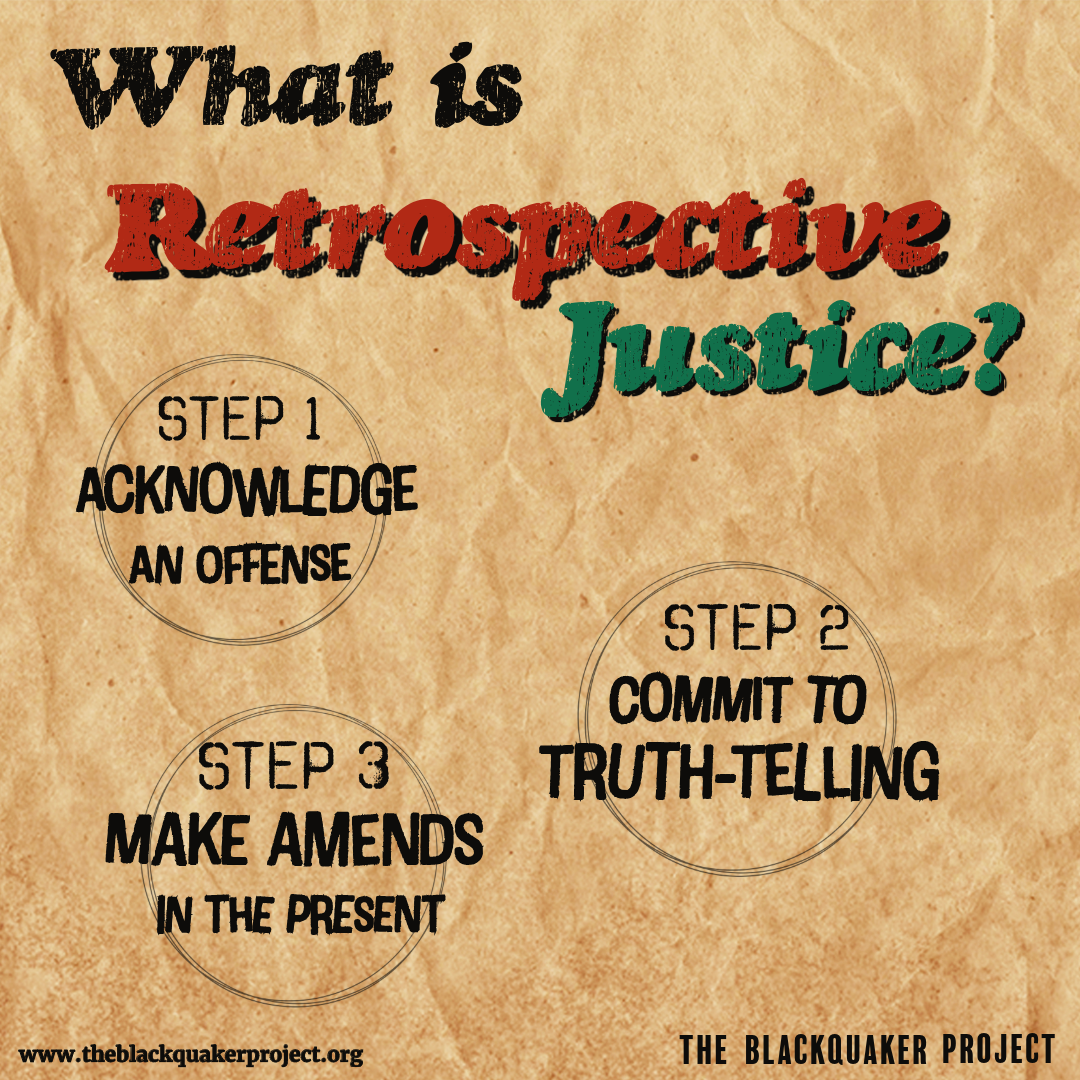
The BlackQuaker Project (BQP) continues to propose that Quakers adopt a model of Retrospective Justice to address our historical involvement in these crimes against humanity. To learn more, we encourage Friends to read our 2020 Pendle Hill pamphlet, Race, Systemic Violence, and Retrospective Justice: An African American Quaker Scholar-Activist Challenges Conventional Narratives, or listen to as a 2026 audiobook.
BQP director Hal Weaver invites you to share your feelings or thoughts at this point: theblackquakerproject@gmail.com.
- How do you feel about the ways in which 18th-century Quakers, as merchants and bankers, played leadership roles in–and profited from–slavery and the triangular trade?
- Are there stories of Quaker involvement in slavery and the trans-Atlantic slave trade that you wish to bring to the attention of our ministry?
- How are Monthly and Yearly Meetings–as well as Quaker organizations and foundations–responding to Friends’ historical involvement in slavery and the slave trade?
- How can we, as individual Quakers, respond to these past injustices in accordance with our model of Retrospective Justice?
- What has happened to the generational wealth Quakers gained from chattel slavery and the triangular trade? Who has inherited these profits in the present? What do these inheritors owe society?
Postscript: Important New Information from FWCC for Yearly Meetings Worldwide
The FWCC World Office has just released 3 queries that Yearly meetings are requested to answer during the 2027 Global Online Conference, “Sowing Seeds of Justice,”
26 September-4 October 2027. We invite Friends to consider these official queries, listed below, and how you might contribute to your Yearly Meeting’s response.
- What acts of injustice, prejudice, and discrimination occurring in your communities could your Yearly Meeting be aware of and take action on?
- What learnings from our Quaker history are there that may be applicable to helping address current injustices and inequities?
- How are you sowing seeds of justice, reconciliation, and hope?
As always, the BQP welcomes any thoughts or feelings you wish to share with us: at theblackquakerproject@gmail.com.
Peace and Blessings,
The BlackQuaker Project
Wellesley Friends Meeting,
New England Yearly Meeting of Friends (Quakers)
3 June 2026
 Friends Association for Higher Education