Monthly Archives: June 2026

FAHE Conference 2026 Epistle

Greetings to Friends, everywhere:

Friends Association for Higher Education held its annual conference from June 2-8, 2026, at William Penn University in Oskaloosa, Iowa. Since 1981, FAHE has been lending support and encouragement to Quakers at Friends colleges and universities as well as those at non-Quaker institutions. Among our various purposes, our organization helps to clarify and articulate the distinctively Quaker vision of higher education, in terms of both curriculum and teaching. We assist the Quaker colleges and universities in affirming their Quaker identity. We invite Friends to join us.

This year, the conference theme was “A Quaker Pedagogy.” There were fifteen presentations in addition to the three plenary speakers responding to such queries as: what makes Quaker education unique, how being at a Quaker institution shapes instruction, and what the lived testimony that underlies our pedagogy offers the wider world of Quaker education.

Each morning we worshipped together; on Tuesday, Mimi Holland led us in semi-programmed worship where we joined our sacred harps together in hymns. On Wednesday, Randall Nichols led us in unprogrammed worship at Coal Creek Meeting House, a short distance from the University, where his great grandparents were married and where his great grandmother’s wedding dress hangs. And on Thursday, Jacci Stuckey shepherded us as we worshipped in the unlit underground while violent weather passed above us.

Monday, the first evening of the conference, we heard a plenary talk by Philip Clayton, “What We Teach and How We Teach it: Pedagogy and the Quaker Way of Being in the World.” Philip guided us in exploring different commitments that inspire Quaker pedagogy: being fully present and focused on what is happening right now and then doing something redemptive; entering the classroom or learning space as a full person listening for small leadings from God; following a Jesuanic pedagogy; balancing acquired knowledge and experienced knowledge; creating a classroom that is a community after the manner of Friends; and committing ourselves to our interconnectedness, the sacredness of the Other, and authenticity. We also examined how Quaker pedagogy sometimes parallels the Buddhist mindset.

Tuesday invited us into further discovery. In her presentation, “Implementing the Commonplace Book in the Modern Quaker Classroom,” Amy Andreassen (re)introduced us to the practice of the Commonplace Book–a book we curate and gather and edit as we read (and experience life) “pen in hand.” Paul Anderson then presented on “D. Elton Trueblood, the Order of Common Life, and Spiritual Renewal.” Paul wove concepts from Trueblood’s four programmatic books into memories and anecdotes of their time together.

Tuesday was also the second plenary session. Via Zoom, from his home in Kaimosi, Kenya, Robert Wafula presented “A Quaker Pedagogy from the African Perspective.” Robert spoke about how education is a communal endeavor–no one is educated for themself–and how identity develops with others. He also spoke about the theology of imago Dei and the Kenyan Quaker intertwining of the SPICES with African Indigenous wisdom. Lastly, Robert led us through an exploration of specific ways that each of the SPICES is reflected in the pedagogy of Friends Theological College in Kenya, again underscoring that they are often woven together with African systems.

After this Lisa Payne Ossian spoke about Herbert Hoover’s work for famine relief and his ideas about humanitarian obligations to Germany post World War Two, in her presentation, “The Hoover Plan: A Moral and Spiritual Reconstruction, 1947.” Michelle Rhea then presented, “Problem-Based Learning as Quaker Pedagogy: Clinical Reasoning, Communal Discernment, and Whole-Person Formation in Physician Assistant Education.” This is a pedagogy that, comparable to a Quaker Clearness Committee, starts with a problem/dilemma, and is based in quietness where answers are not given. What is taught rather is a process that leads to answer finding.

Tuesday afternoon we heard a presentation called, “Teaching as Testimony: Preparing Educators Through Christ-Centered Quaker and Mennonite Values” from Dana Oswald. Dana used the SPICES to illustrate how utilizing Mennonite and Quaker values can improve teaching practices. After that Wilton Wright and Destiny Kiddoo presented “Co-Teaching as Quaker Pedagogy,” using their experience of co-teaching as a way of modeling community values, collaboration, multiple perspectives, and trust in the person you are teaching with.

Tuesday evening Middle River Friends Church hosted us for a potluck near Carlisle, Iowa and we had the opportunity to tour the Norman E. Borlaug Hall of Laureates at the World Food Prize Center in Des Moines.

We began Wednesday at Coal Creek Meeting House at Nelson Pioneer Farm, with a presentation from Neil Cantrall, “How Silent Worship Shapes the Practice of Educators.” Neil spoke of how including a period of silent (waiting/expectant) worship creates the opportunity for preparation–spiritual and otherwise–for listening, receptivity, and learning. After that, Amy Andreassen presented, “The Hidden Teacher: Reclaiming the Sacred Rhythm of Rest,” where she discussed seven pitfalls that lead to “Hurry Sickness” and seven practices to combat it.

After we returned to the William Penn campus nine presidents of Quaker colleges joined us online to discuss the state of Quaker Higher education at their respective institutions.

Jacci Stuckey presented, “Quaker Pedagogy at a Holiness Friends University,” examining the question of how we might continue to look back into history to help move us forward holding onto our Quaker and Christian values. George King then presented, “Discovering a Quaker Pedagogy of Attunement: Reflections from an Ecological Outsider”–insights and observations he’s made about Quaker pedagogy as an outsider. He spoke about a communal attunement and a stewardship of attention. He noticed that Quakerism encourages us to listen first and teach second.

Wednesday afternoon we heard a presentation, “Centering the Human: Quaker Pedagogy in the Onslaught of AI” from Don Smith. This presentation helped us understand both the opportunities machine learning provides as well as the dangers of threats it poses. Machine learning (or AI) can reduce repetitive tasks, but it also has the potential to become a giant plagiarism machine and an ethical nightmare. Don reminded us that AI is not a truth machine but a probability machine. After that Mike Heller, in his presentation, “To ‘Be Teachable,’ Mentors and Quaker Faith,” encouraged us to be “teachable” drawing from John Woolman’s journal. Mike noted the ways in which his own mentors were generous with their time with him and we spent time thinking about our own mentors and how Quakerism can inform how we can be teachable and effective mentors.

In Charlotte Stangeland and Dana Oswald’s presentation, “A Quaker Vision: Peace in Our Communities, a Kenyan Peace Curriculum,” we learned that after election violence in Kenya, Quakers in Kenya and Iowa collaborated on creating a curriculum to teach peacemaking and problem-solving skills for children and youth. The curriculum was developed to reflect Quaker values and Kenyan life experiences. Next, Noel C. Stahle presented “Miracle Man: H.W. Van der Merwe: the Quaker Who Brought South Africa Enemies Together.” Van der Merwe was a Quaker anti-apartheid activist who played a leading role in building trust and ending apartheid without massive bloodshed. After he began to think of himself as “African,” he built a nation-wide black-white coalition, which peacefully brought about the end of apartheid.

The final presentation, “Integrity and the Academic Bureaucracy” from Richard Miller, called for integrity of faith and practice. Following fifty plus years of teaching, such issues as Football Thursdays, sexual harassment, two syllabi, chair evaluations, and recruiting majors require us to be patterns and examples after the manner of Friends.

MaryKate Morse closed the conference with her plenary session, “What the World Needs Now: A Quaker Higher Education.” MaryKate argued that Quakers are being asked to step in and take risks to be God’s intervention. After presenting the three main crisis that higher education faces today, she talked about how Quakers are uniquely situated  to be a healing and transformative force, offering specific points about how the Quaker way might support that work: the power of being Christ-centered, Belovedness (that of God in all), continuous revelation, world engagement, and the core values of simplicity, integrity, and peace. She continued, “Education is not just the accumulation of knowledge; it is an intentionally curated culture.” She finished by encouraging us to think about the classroom not as a bunch of desks facing a podium, but rather as a sanctuary and laboratory where spiritual formation, contextual learning, and authentic community model how to be in the world in a different way.

The evening ended with a reception hosted by the Social and Behavioral Sciences Division of William Penn University.

We depart from this gathering in gratitude for the many voices who united to create such a rich exchange of ideas and meaning. We leave also with awe for the power and fragility of the natural world–a testament to the glory and empathy of our Divine Creator.
Comments Off on FAHE Conference 2026 Epistle

Filed under Epistle

Juneteenth 2026 – Quaker Edition

19 June 2026—Juneteenth!
Honoring African American Quakers in the Anti-Slavery & Suffrage Movements

Happy Juneteenth from the BlackQuaker Project!

A national holiday commemorating the end of slavery in the USA, Juneteenth was signed into law by President Joe Biden on 17 June 2021. This gave federal recognition to a tradition of celebration practiced among African Americans since Union troops arrived in Galveston, Texas, on 19 June 1865 to inform enslaved African Americans of their freedom, decreed in Abraham Lincoln’s Emancipation Proclamation of 1 January 1863.

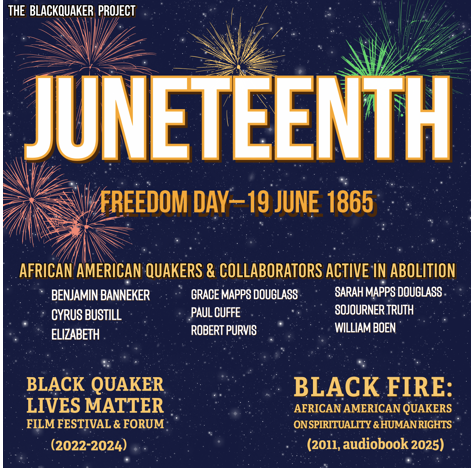
This year our ministry wishes to spotlight the involvement of African American Quakers in the anti-slavery and women’s rights movements. Today we bring to your attention nine trailblazing African American Quaker abolitionists and suffragettes active within the Black liberation struggle during the 18th and 19th centuries. We hope Friends take inspiration from these remarkable life stories as we approach the 2027 Friends World Committee for Consultation’s (FWCC) Global Online Gathering (29 September to 3 October), during which yearly meetings worldwide will reflect on how their local communities have worked to confront historical and contemporary injustice.

AFRICAN AMERICAN QUAKER SEEKER-ACTIVISTS

Benjamin Banneker 

(9 November 1731 – 9 October 1806)

Born to a free family of Senegalese descent, Banneker was a largely self-educated mathematician, astronomer, and inventor who was recruited by Friend George Ellicott to survey the boundaries of Washington, D.C. Known for his rigorous almanacs, Banneker used his platform as a prominent African American intellectual to challenge notions of white supremacy by including speeches from leading USA and UK abolitionists in his publications. Most notably, Banneker denounced the hypocrisy of Thomas Jefferson, penning a searing 1791 letter to the Founding Father–then Secretary of State–which critiqued the contradictions between the equality Jefferson wrote of in the Declaration of Independence and the brutal realities of USA chattel slavery.

Cyrus Bustill

(2 February 1732 – 1806)

Cyrus Bustill, formerly enslaved, became a successful baker, businessman, and community leader in Philadelphia. After gaining his freedom, he used his skills as a baker to build a prosperous business and even baked bread for George Washington’s troops as they crossed the Delaware River during the Revolutionary War. Bustill co-founded the Free African Society, which provided assistance to free African Americans and laid the foundation for later Black institutions. Cyrus Bustill is an ancestor of the towering 20th-century African American pan-Africanist, bass-baritone concert and recording artist, stage and screen actor, all-American athlete, and scholar Paul Robeson.

William Boen 

(1735 – 1824)

A farmer born into slavery in New Jersey who later gained his freedom, William Boen was one of the earliest African Americans to de-segregate the Religious Society of Friends. His petitions to join the Society were rejected four times before he was able to become a member of Mount Holly Friends Meeting in 1814.

Paul Cuffe 

(17 January 1759 – 7 January 1817) 

Born to a formerly enslaved father and a Wampanoag mother, Cuffe grew up to be a successful merchant sea captain, owning several ships. As one of the wealthiest free African Americans in the USA, Cuffe built and funded one of the first racially integrated schools in the United States, guaranteed the construction of the Westport (MA) Friends Meetinghouse, and established trade connections between the USA and Sierra Leone, West Africa. Cuffe was a leader in efforts to organize repatriation for enslaved peoples as an escape from chattel slavery in the USA. A fierce critic of early American democratic institutions, Cuffe served jail time during the Revolutionary War for refusing to pay taxes to a country that deprived him and other African Americans of the right to vote.

Elizabeth

(1766-1866) 

Born into slavery, Elizabeth, who refused to marry or take a surname, was a regular attender at Quaker meetings who became an itinerant Methodist Minister active throughout the USA and Canada. She was known for giving sermons condemning chattel slavery, would preach to interracial congregations in Baltimore despite institutional opposition to her presence, and even established a school for Black orphans.

Sojourner Truth 

(1797 – 26 November 1883)

A legendary abolitionist and women’s rights movement leader, Sojourner Truth was born into slavery in New York as Isabella Baumfree. Escaping to freedom in 1826, she successfully sued for custody of her son, who had been sold to an Alabama slave owner. Sojourner became known as a fierce public orator who traveled the country giving speeches calling for the liberation of African Americans, women, and most especially Black women, whom she argued were routinely excluded from the women’s rights movement. She notably challenged prominent suffragists of her era to recognize the struggles of African American women in her historic, impromptu speech, “Ain’t I a Woman?,” at the 1851 Women’s Convention in Akron, Ohio.

Grace Mapps Douglass 

(1782 – 9 March 1842) 

A pioneering abolitionist and women’s rights activist, Grace Bustill Douglass was born to Cyrus Bustill and Elizabeth Morey, a Quaker of English descent whose ancestry can be traced back to Friend Humphey Morey, the first Mayor of Philadelphia. Excluded from the all-male Philadelphia Anti-Slavery Society, she became a founding member of the Philadelphia Female Anti-Slavery Society in 1833, working alongside prominent Black and white activists, such as Lucretia Mott and the Grimké sisters, to lobby the federal government to abolish slavery, organize boycotts, and provide aid to the Underground Railroad. Though a descendant of several generations of Quakers stretching back to the Mayflower, Grace and her daughter—Sarah Mapps Douglass—were forced to sit in segregated seating on the back bench of Arch Street Meeting in Philadelphia. Like her father, Grace was an ancestor of the 20th century renaissance man Paul Robeson.

Sarah Mapps Douglass 

(9 September 1806 – 8 September 1882)

Following in the footsteps of her mother, Grace Mapps Douglass, Sarah was a trailblazing abolitionist, writer, educator, and activist. A lifelong teacher, she taught at schools throughout Philadelphia where she could support Black students, later founding a private school for African American girls and co-founding the Female Literary Association (1831), one of the earliest literary and social societies for African American women in the country. Later in life, she studied anatomy and health at the Female Medical College of Pennsylvania, becoming one of the first African American women known to receive formal training in medicine. All the while, Douglass published influential writings that addressed issues of race, gender, education, and social reform, helping to shape public discussion of these topics. Like her mother, Grace, and her grandfather, Cyrus Bustill, Sarah is a member of the eminent Bustill-Douglass Quaker family whose descendants include Paul Robeson.

Robert Purvis 

(1810-1898) 

Robert Purvis was a leading African American abolitionist who worked closely with major anti-slavery activists of his time such as William Loyd Garrison and Lucretia Mott. A key figure in the Pennsylvania chapter of the Underground Railroad, Purvis offered his home near Philadelphia as shelter to hundreds of African Americans escaping slavery. Purvis was not only a founding member of the Philadelphia Anti-Slavery Society but chaired Philadelphia’s General Vigilance Committee which provided aid, medical care, and legal defense to freedom seekers while coordinating the activities of the Underground Railroad in Pennsylvania. While he worked extensively with Quakers in Philadelphia, Purvis remained only a collaborator and not a member of the Society of Friends, possibly due to a refusal to accept non-violence. Though not a Quaker, his children to Quaker schools, and lived across the street from Byberry Friends Meeting with his wife, Friend Tracey Townsend, who renounced her membership in the Society of Friends shortly after their marriage.

FURTHER READING

We hope these innovative resources will aid those seeking truth and justice, and encourage you to write to us at theblackquakerproject@gmail.com with any reflections, insights, or questions you may have.

  • Angell, Stephen W. “The Early Period.” Black Fire: African American Quakers on Spirituality and Human Rights, edited by Harold D. Weaver Jr., Paul Kriese, and Stephen W. Angell. Quaker Press of FGC, Philadelphia, 2011, pp. 1–43.
  • For further information on the F/friends discussed in today’s e-newsletter–with the exception of Cyrus Bustill and Grace Mapps Douglass–please see our 2011 anthology now available as an 2025 audiobook.
  • Gordon-Reed, Annette. ON JUNETEENTH. New York: Liveright Press, 2021.

Peace and Blessings,

The BlackQuaker Project
Wellesley Friends Meeting, 
New England Yearly Meeting of Friends (Quakers)
www.theblackquakerproject.org
19 June 2026: Juneteenth!

Comments Off on Juneteenth 2026 – Quaker Edition

Filed under Announcements

The 2026 FAHE Conference

The 2026 FAHE Conference has now concluded. Many thanks to William Penn University for hosting, and thanks to all of the organizers and presenters! We will soon be posting the conference epistle, as well as recordings of some of the sessions. Watch this space!

Comments Off on The 2026 FAHE Conference

Filed under Annual Conference

BlackQuaker Project Newsletter: Quaker Merchants & Bankers Deeply Involved in Slavery

“[Many] of the men most responsible for institutionalizing the cotton triangle at the heart of America’s slave industries…were all Quakers.”

–David Montero, The Stolen Wealth of Slavery: A Case for Reparations (2024)

Happy Pride Month from the BlackQuaker Project (BQP)!

As Juneteenth–celebrated nationally on 19 June–approaches, our ministry wishes to spotlight breakthrough scholarship on the central financial role of Quakers in the trans-Atlantic slave trade and chattel slavery. We will share excerpts from the sobering book that brought these revelations to our attention, re-affirm the importance of Retrospective Justice in addressing past injustice, offer queries for reflection, and share important news from the Friends World Committee for Consultation (FWCC).

The BlackQuaker Project is thoroughly disappointed to learn of the deep, central, and lucrative involvement of northern Quakers–merchants and bankers especially–in the institution and industry of chattel slavery in the Americas. These uncomfortable truths can be found in David Montero’s The Stolen Wealth of Slavery: A Case for Reparations, which uncovers the extent to which economic elites in the North participated in—and profited from—the enslavement of African people.

For nearly 400 years, cash crops and precious metals (such as iron, gold, and silver) produced by enslaved Africans in the Americas flowed into European factories, where they were processed into textiles, rum, and firearms that were shipped to Africa and exchanged for kidnapped Africans, who were then trafficked through the Middle Passage to the Americas, where a lifetime of brutal labor awaited them. This vicious cycle, known as the triangular trade, would not have been possible without North American merchants, who brought ruthless speed and efficiency to the logistics of the slave trade, and bankers, who funded both the trade and Southern plantations–all from which they amassed enormous, generational wealth. Montero reveals an extensive web of aristocratic Northern families who intermarried and profited from slavery even more than their Southern counterparts. Most notable for our ministry is the revelation that Quaker businessmen and Quaker businesses exploited people of African descent mercilessly and hypocritically, playing an integral role in establishing and financing these dehumanizing institutions for generations while, in some cases, claiming to be abolitionists. Today we share select excerpts from this publication, personally chosen for our readership by author David Montero, whose book is now available to purchase from Hatchett Books and Amazon

Excerpts from The Stolen Wealth of Slavery: A Case for Reparations (2024)

Selected by author David Montero:

QUAKER INVOLVEMENT IN SLAVERY: COTTON SHIPPING, THE BLACK BALL LINE, AND CITIBANK

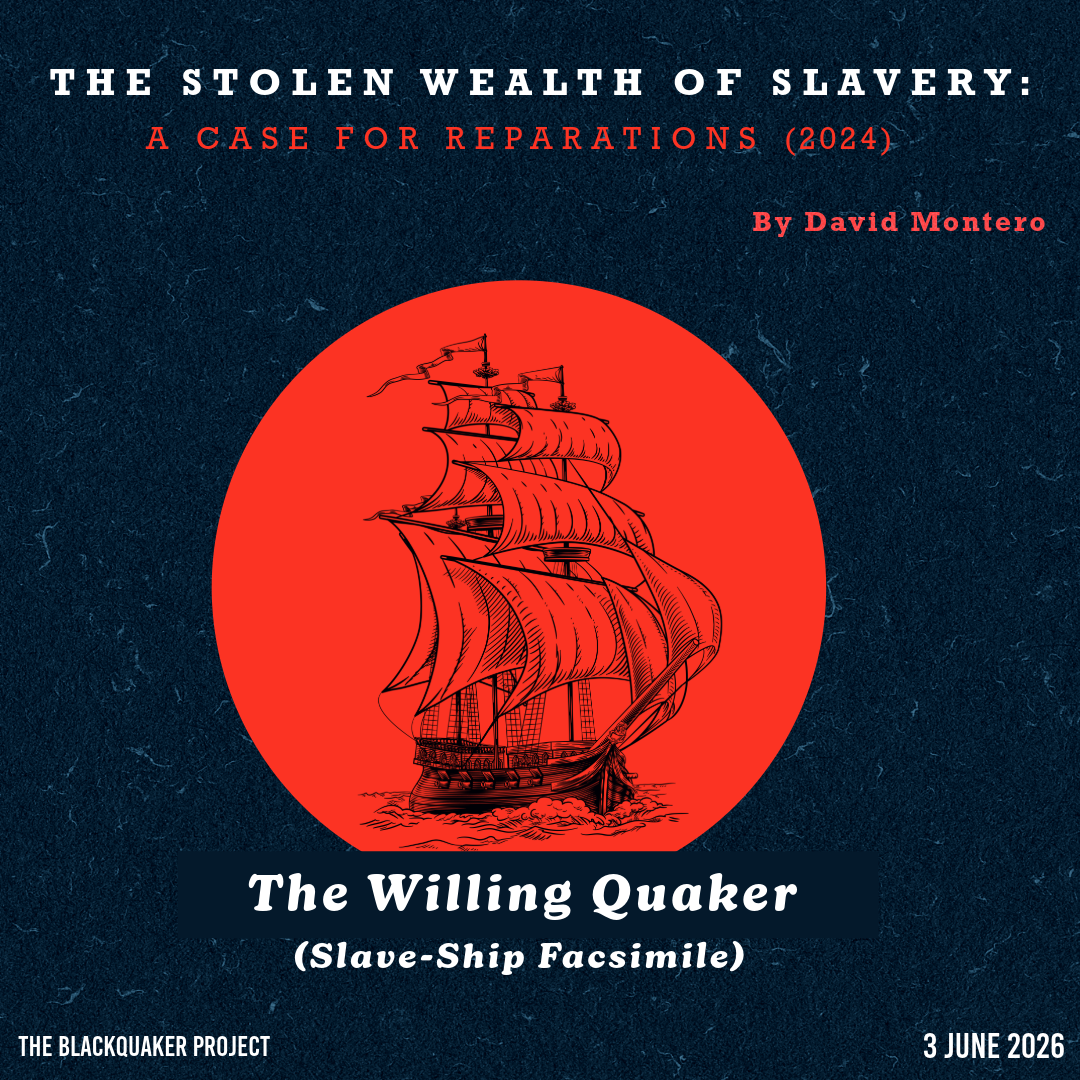
[Many] of the men most responsible for institutionalizing the cotton triangle at the heart of America’s slave industries—Francis Thompson, Isaac Wright, and Jeremiah Thompson—were all Quakers. In Capitalism and Slavery [1944], Eric Williams observed that “slave dealing was one of the most lucrative investments of English as well as American Quakers, and the name of a slaver [ship], The Willing Quaker,…symbolizes the approval with which the slave trade was regarded in Quaker circles.”

Between 1818 and 1828, Jeremiah Thompson, a Quaker, sold and shipped so much cotton abroad that he was considered the foremost cotton exporter in the United States—referred to by some as the country’s first “cotton king”—as well as the nation’s largest shipowner.

In 1818, [Benjamin] Marshall, together with Francis Thompson, his nephew Jeremiah Thompson, and Isaac Wright, launched a new line of commercial ocean liners. They explained in a letter to one of Liverpool’s leading cotton houses: “These ships shall leave New York, full or not full, on the 5th, and Liverpool on the 1st, of every Month throughout the year.” Regular service, dependable timing, shipping that ran like a machine, something never done before. It constituted nothing less than a revolution in transportation and the business of slavery.

The first of their ships to set sail for Liverpool was called the James Monroe, and its hull was filled mostly with apples, and only seventy-one bales of cotton. But, as advertised, despite the paucity of its cargo, it sailed, nonetheless. Its flag was a red blazon with a black ball at its center. As a result, the first of the regularized transatlantic ocean liners became known as the Black Ball Line. Three other ships followed the James Monroe, each about one hundred feet long and four hundred tons in carrying capacity. All lost money in the beginning, being too capacious, and too empty. But Black Ball’s owners had the capital to wait it out. Success did come, roughly by 1820, and it changed shipping, enslavement, and New York forever. “From the sailing of this packet,” wrote Grant Thorburn in 1845, “we may date the day from whence the commerce of New-York began to increase seven-fold.”

The Black Ball ships were soon loaded up, as the idea of regular cotton shipments caught on, spawning an industry of competitors and imitators—the Red Star Line in 1821, the Blue Swallowtail in 1822, among others—that opened numerous additional lines across the Atlantic, and down the coasts to southern plantations as well. All sides of the cotton triangle began to flow regularly and exponentially.

A “commercial marine” emerged, as the Southern Literary Messenger of Richmond later called it, “which whitens every sea, and carries the products of American industry into all ports open to her flag.”

So began an ever more concentrated flow of cotton passing through New York, and for this reason, by 1820 New York surpassed Philadelphia and Boston as a center of trade. South Street and its docks sat at the center of the world’s most important economic triangle, the greatest wealth engine the world had ever seen.

The emerging institutional link between cotton, slavery, and Wall Street in this period was nowhere more poignantly reflected than in the relationship between City Bank and the personage of Isaac Wright. Wright had long been a prosperous cotton shipper. In 1825, as his fortunes rose even higher through Black Ball, he was elected a City Bank director. Thus, the bank profited considerably from its close relationship with the revolution he, Marshall, and Thompson had unleashed. Meanwhile, Wright and his business, Isaac Wright & Co., prospered from the bank’s services and pool of credit. In fact, so important was Wright and his slavery-dependent business that he was elected president of City Bank in 1827, serving in that position for five years.

The central role City Bank played in underwriting Wright’s shipping line is one the bank itself has proudly, though deceptively, emphasized for decades. The “Heritage” section of Citi’s website underscores the bank’s ties to Quakers and the Black Ball, while whitewashing the connection to enslavement. “Many of the bank’s early leaders were significant figures in the New York merchant economy,” it reads. “Quaker merchant Isaac Wright, a one-time board director and bank president, was a leading importer of British textiles. He founded the Black Ball Line, which was believed to be the first regular packet line service between New York and Liverpool. Benjamin Marshall, his partner in the shipping line, joined the board as well.”

The bank was careful then, as it has been ever since, to avoid highlighting that, in doing so, it helped launch a revolution in the commerce of slavery, a milestone that directly facilitated the exploitation of Black people to expand exponentially.

[Selected and excerpted from pages 37 and 247]

About the Author

David Montero is an award-winning journalist, author, and producer whose writing has been featured in The New York Times, The Nation, The Harvard Business Review, and Le Monde Diplomatique. He has been twice nominated for an Emmy Award for his work on PBS’s flagship investigative series, FRONTLINE. Currently, Montero serves as Artist-in-Residence at the Slavery North Initiative, an academic and cultural research center at the University of Massachusetts, Amherst, dedicated to investigating the under-researched history of slavery in the northern USA and Canada. His books include Kickback: Exposing the Global Corporate Bribery Network (2018) and The Stolen Wealth of Slavery: A Case for Reparations (2024). 

Food for Thought and Action

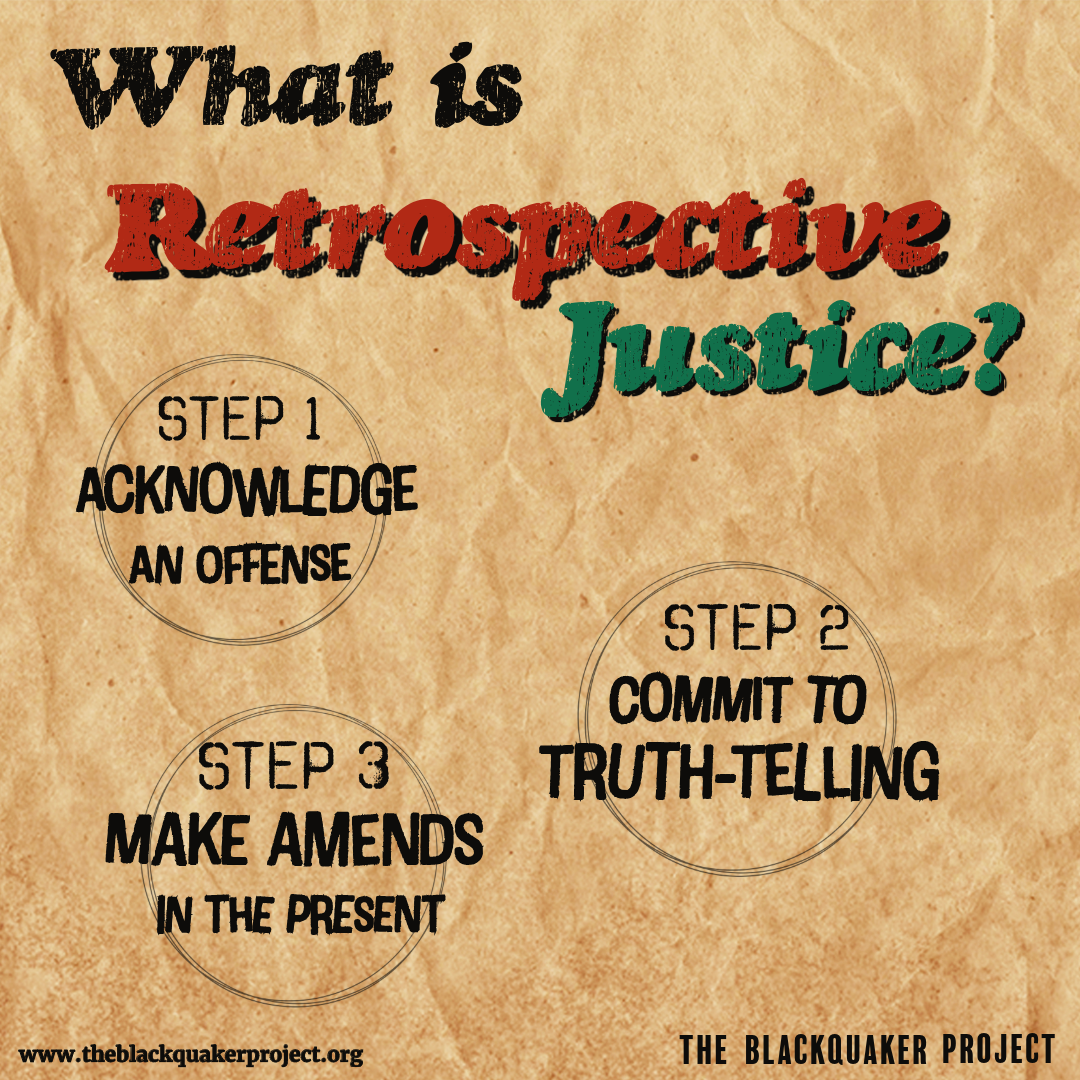
The BlackQuaker Project (BQP) continues to propose that Quakers adopt a model of Retrospective Justice to address our historical involvement in these crimes against humanity.  To learn more, we encourage Friends to read our 2020 Pendle Hill pamphletRace, Systemic Violence, and Retrospective Justice: An African American Quaker Scholar-Activist Challenges Conventional Narratives, or listen to as a 2026 audiobook.

BQP director Hal Weaver invites you to share your feelings or thoughts at this point: theblackquakerproject@gmail.com.

  • How do you feel about the ways in which 18th-century Quakers, as merchants and bankers, played leadership roles in–and profited from–slavery and the triangular trade?
  • Are there stories of Quaker involvement in slavery and the trans-Atlantic slave trade that you wish to bring to the attention of our ministry?
  • How are Monthly and Yearly Meetings–as well as Quaker organizations and foundations–responding to Friends’ historical involvement in slavery and the slave trade?
  • How can we, as individual Quakers, respond to these past injustices in accordance with our model of Retrospective Justice?
  • What has happened to the generational wealth Quakers gained from chattel slavery and the triangular trade? Who has inherited these profits in the present? What do these inheritors owe society?

Postscript: Important New Information from FWCC for Yearly Meetings Worldwide

The FWCC World Office has just released 3 queries that Yearly meetings are requested to answer during the 2027 Global Online Conference, “Sowing Seeds of Justice,”

26 September-4 October 2027. We invite Friends to consider these official queries, listed below, and how you might contribute to your Yearly Meeting’s response.

  • What acts of injustice, prejudice, and discrimination occurring in your communities could your Yearly Meeting be aware of and take action on?
  • What learnings from our Quaker history are there that may be applicable to helping address current injustices and inequities?
  • How are you sowing seeds of justice, reconciliation, and hope?

As always, the BQP welcomes any thoughts or feelings you wish to share with us: at theblackquakerproject@gmail.com.

Peace and Blessings,


The BlackQuaker Project

Wellesley Friends Meeting, 

New England Yearly Meeting of Friends (Quakers)

www.theblackquakerproject.org 

3 June 2026

Comments Off on BlackQuaker Project Newsletter: Quaker Merchants & Bankers Deeply Involved in Slavery

Filed under Announcements