Author Archives: Laura Rediehs

About Laura Rediehs

I teach philosophy and peace studies at St. Lawrence University, and play flutes.

Volunteer Copyediting

The Quaker Studies journal is reaching out for assistance with copyediting, as part of their ongoing commitment to excellence in scholarly publishing.

Quaker Studies is a peer-reviewed journal dedicated to advancing understanding and scholarship in the field of Quaker history, theology, and practice. As you may know, Quaker Studies is now a part of the Open Library of the Humanities (OLH) publication system. With this move, they are faced with the responsibility of copyediting the journal, as this is not a service provided by OLH. As they strive to maintain the highest standards of academic rigor and clarity, assistance with copyediting would be immensely valuable in ensuring the quality and accuracy of the articles they publish.

They are currently seeking volunteers who possess a keen eye for detail, a strong command of English grammar and style, and a familiarity with academic writing conventions. Your role would involve reviewing manuscripts for consistency, clarity, and adherence to the journal’s formatting guidelines.

This is an excellent opportunity to contribute to the dissemination of knowledge within the Quaker community and beyond, while also gaining valuable experience in academic publishing. Moreover, your involvement will directly support the scholarly endeavors of Quaker Studies authors and enhance the overall quality of the journal.

If you are interested in volunteering your time and expertise to help copyedit Quaker Studies, please contact Rhiannon Grant and Rebecca Wynter, editors of the journal: (rhiannon.grant@woodbrooke.org.uk and r.i.wynter@bham.ac.uk).

Thank you for considering this opportunity to support Quaker Studies through your valuable contributions. Should you have any questions or require additional information, please do not hesitate to reach out.

Comments Off on Volunteer Copyediting

Filed under Opportunity

Moore Research Fellowship

Calling all scholars of Quaker history, Peace history, and allied topics! Swarthmore College Special Collections is now accepting applications for our Moore Research Fellowship for the 2024-2025 cycle.

The Margaret W. Moore and John M. Moore Research Fellowship promotes research during the academic year or summer months using the resources of the Friends Historical Library and/or the Swarthmore College Peace Collection, providing a stipend of $1,500-$6,000 to support such research. Applications are due April 1, 2024.

Please share this announcement with all who might be interested. More details and application instructions are here:

https://www.swarthmore.edu/friends-historical-library/moore-research-fellowship

Comments Off on Moore Research Fellowship

Filed under Fellowships

Black History Month Quaker Events

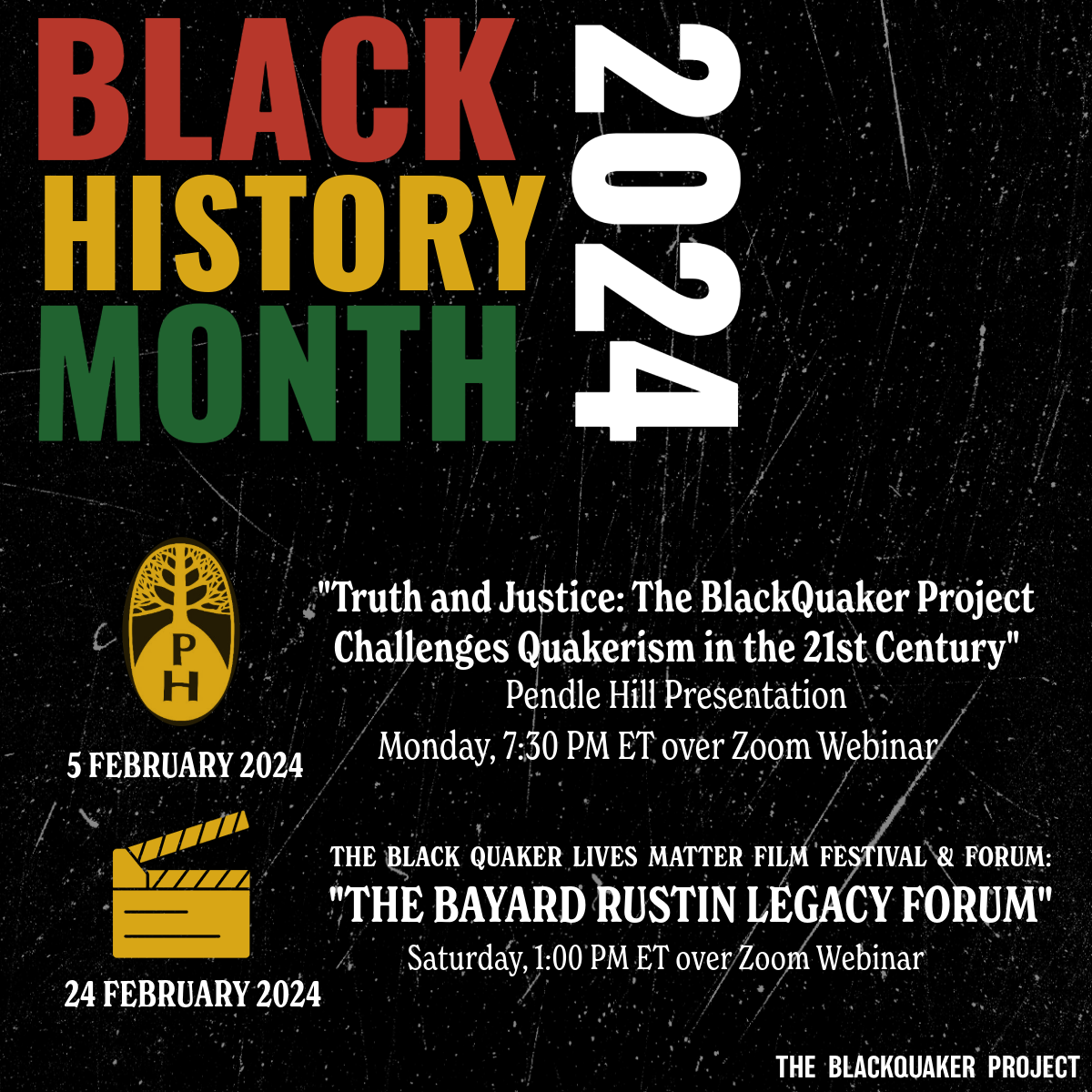
The BlackQuaker Project brings exciting news of two unique, online events we will be offering during this 2024 Black History Month.  

Monday, 5 February – “Truth and Justice: The BlackQuaker Project Challenges Quakerism in the 21st Century,” a Pendle Hill First-Monday Lecture

7:30 PM – 9:00 PM EST (Zoom Webinar)

Join us for a radical Pendle Hill presentation in which special guest Nozizwe Madlala-Routledge joins Dr. Harold D. Weaver Jr. and the BlackQuaker Project team. Together they will present a new model for healing historical injustice with Retrospective Justice and showcase how our ministry, along with other Friends of Color around the world, are challenging Quakerism in the 21st century with new insights and new narratives. Register here to attend.

Saturday, 24 February – “The Bayard Rustin Legacy Forum” 

1:00 PM – 3:00 PM EST (Zoom Webinar)

The BlackQuaker Project and Swarthmore College’s Department of Peace and Conflict Studies present “The Bayard Rustin Legacy Forum,” a virtual symposium sponsored by the American American Friends Service Committee, hosted by Dr. Harold D. Weaver Jr., and moderated by Palestinian-American Quaker scholar-activist Dr. Sa’ed Atshan. They will be joined by Haverford College Africana and Religious Studies scholar, Dr. terrence wiley, and Friends Council on National Legislation administrator, Lauren Brownlee, for a series of presentations on the remarkable legacy of Friend Rustin, followed by an audience Q & A. Our distinguished panel will engage with the 2023 biopic Rustin, which we recommend viewing prior to this one-time event. Register here to attend.

Comments Off on Black History Month Quaker Events

Filed under Online Events

Fox at 400: Call for Proposals

Fox at 400: The Life, Times, and Legacies of George Fox – A Joint Conference of the Conference of Quaker Historians and Archivists, Centre for Research in Quaker Studies, and the Quaker Studies Research Association

Lancaster University
Lancaster, England
June 20-23, 2024

Call for Proposals

Here is full information

The deadline for proposals is December 4, 2023.

*Please note the deadline for Early Bird Registration is January 31, 2024*

Comments Off on Fox at 400: Call for Proposals

Filed under Announcements, Call for Proposal

Quaker Colleges Respond to Supreme Court Decision

As described by this article from the Chronicle of Higher Education:

“The U.S. Supreme Court on Thursday struck down colleges’ use of race-conscious admissions nationwide, ruling in a pair of closely watched cases that the practice is racially discriminatory.

“Writing for the court’s majority, Chief Justice John G. Roberts Jr. said that policies that claim to consider an applicant’s race as one factor among many are in fact violating the equal-protection clause of the 14th Amendment to the U.S. Constitution.”

Further follow-up from the Department of Justice and Department of Education, August 14, 2024.

Here is a video from the Wall Street Journal exploring potential effects.

Some of our member institutions have issued statements in response. Here are links to the statements we could find so far:

Bryn Mawr College statement

Earlham College statement

Guilford College statement

Haverford College statement

Swarthmore College statement

(Updated August 14, 2023)

Comments Off on Quaker Colleges Respond to Supreme Court Decision

Filed under Announcements

2023 FAHE Conference Archive

2023 FAHE Conference Archive

Overview

Opening Plenary

Plenary Sessions

Recorded Concurrent Sessions

  • ​Native Women and Allies Speak
    • ​​Donna Frann-Boyle (Choctaw and Cherokee)
    • ​​Ramona Woods (Mohawk)
    • ​​Kelley Bova (Dakota)
    • ​​Arla Patch
    • ​​The Coalition of Natives and Allies

Concurrent Sessions Power Points


(If other presenters have documents to contribute to the archive, please send them to FAHE_Annual_Conference@quakerfahe.com)

Comments Off on 2023 FAHE Conference Archive

Filed under Annual Conference

Sad News: Lonnie Valentine

We have received the sad news that Lonnie Valentine passed away on June 19, 2023. Lonnie was a member of FAHE, served on the Executive Committee in the past, presented frequently at our conferences and helped organize them when hosted by Earlham, and was editing the Quakers and Future of Peacemaking volume of our Quakers in the Disciplines book series. Here is further information from the Earlham School of Religion, where he was Professor Emeritus of Peace and Justice Studies:

Submitted by April Vanlonden (ESR Class of ’04 and Joint Seminaries Registrar – Earlham School of Religion):

With hearts broken that carry an abiding sense of gratitude, the Earlham School of Religion (ESR) community shares the passing of Professor Emeriti of Peace and Justice Studies, Lonnie Valentine, on June 19, 2023, during treatment for Primary Cerebral Lymphoma. Lonnie retired from ESR at the close of the 2021‐22 academic school year.

Lonnie earned a B.A. from Raymond College, University of the Pacific in 1970, a B.A. in Philosophy and Religion, University of California, Irvine in 1975, an M.S. from Loyola College, an M.A. in Religion from Earlham School of Religion in 1983, and a PhD in Constructive Theology from Emory University in 1989.

Lonnie returned to teach at ESR in 1989 and was part of the creation of the area of emphases in the MDiv program. His broad training and experience enabled him to teach Ethics, Interfaith Dialog, Moral and Faith Development, Spirituality and Peacemaking, Liberation and Process Theologies, and Biblical Violence and Non‐Violence. Lonnie was known for his personal history of tax resistance and other justice actions, leading students on trips to protest the School of the Americas and accompanying groups of students to Friends Committee on Legislation Annual Conferences. A strong advocate for the student, Lonnie led educational trips to India and shepherded the numerous international students who came to study at ESR. Towards the end of his career at ESR, Lonnie designed and implemented the new Master of Arts in Peace and Social Transformation, a program that continues to attract students. Lonnie served as the clerk of the ESR faculty and as Academic Dean in his 33 years at ESR.

Widely published, Lonnie’s works are in The Oxford Handbook of Quaker Studies, Quaker Religious Thought, Friends Association of Higher Education publications, among others. Always willing to pitch in, Lonnie offered countless presentations at National Peace conferences, Yearly Meeting annual sessions, Church of the Brethren gatherings, American Academy of Religion, Friends World Committee for Consultation, the National War Tax Resistance Coordinating Committee, individual monthly meetings, churches, and to anyone willing to join with him in the pursuit of peace.

An accomplished academic and sought‐after presenter, Lonnie was loved by the hundreds of students he taught at ESR and Bethany Theological Seminary and as well as those throughout the wider Quaker community. After Lonnie’s passing, messages flooded in, relating stories of the impact Lonnie had on the students of ESR and Bethany, and how this impact guides their work throughout this world. Lonnie was a ready participant in student activities, gatherings, meals, and endeavors of ministry, willing to lend a hand if any called or simply join in the various celebrations of their lives.

Lonnie is survived by his wife, Genevieve Baird, daughter Cady (EC ’05‐’07), son Ben (EC Class of ’09), grandson, Sovann, and the countless who go forth in his ministry. As Lonnie would say, “Carry on.”

To honor Lonnie for his many years of service, teaching, and care for his community, ESR will be raising money for a restricted fund for the Peace and Justice Program in Lonnie’s name. If you are inclined to make an early start and contribute to the yet‐to‐be‐named fund please send a check to ESR or go to the ESR website and indicate your gift is ‘in memory of Lonnie Valentine’. Thank you!

Submitted by April Vanlonden (ESR Class of ’04 and Joint Seminaries Registrar – Earlham School of Religion)

Comments Off on Sad News: Lonnie Valentine

Filed under Announcements

FAHE Conference 2023 Epistle

Greetings to Friends, everywhere: 

From June 12th through 15th, 2023, Friends Association for Higher Education held its annual conference at Haverford College, which is located on the traditional lands of the Lenni-Lenape people.  The theme of the conference was “Quakers, Colonization, and Decolonization.”  It was FAHE’s first in-person conference since 2019, and its very first hybrid conference, offering sessions on Zoom as well.  Friends rejoiced in their time together while also being gratified by all of the benefits of the Zoom option.

During the conference’s opening evening, Friends were welcomed by Nikki Young, Haverford’s inaugural Vice President for Institutional Equity and Access.  James Fenelon who is of both Lakota/Dakota and European heritage then provided a brief overview of the traditions of land acknowledgements as part of the introduction to our keynote speaker, Dennis Coker, Principal Chief of the Lenape Indian Tribe of Delaware.  Chief Coker focused on the traumatic colonization experience of his people, which eliminated 90% of the population due to smallpox outbreaks as well as physical violence, forcing many tribe members to migrate westward or northward to escape extermination.  Nevertheless, a vital community of approximately 1000 Lenape still exists in Kent County Delaware.  After describing the challenging process of obtaining federal recognition for Delaware Lenape, Chief Coker emphasized what the modern United States might learn from indigenous peoples.  Regarding reverence for the environment, he reminded us that nature doesn’t need human beings, but humans do need nature. 

On the first full day of our gathering, following a communal gathering at dawn and a period of silent worship, morning and evening plenary sessions asked us to consider issues and possibilities for decolonizing both Quakerism and the larger society.  The first plenary addressed decolonizing Quakerism around the world.  Panelists from the Philippines (Cristina Montiel), Bolivia (Emma Condori Mamani), Kenya (Oscar Lugusa Malande) and India (P. Govi) shared their perspectives with us and responded to questions from moderator Emma Lapsansky such as, “What would a decolonized peace testimony in the Global South look like?” and, “Can an unprogrammed meeting go South without colonizing?”  It was painfully clear that colonization has been a world-wide phenomenon affecting people of color throughout the globe.

In the second plenary, tom kunesh and James Fenelon addressed the thorny issues confronting decolonizing in the United States:  landback, cultureback, and indigenizing.  The vital importance of cultural indigenizing through attention to language and religion were emphasized, and we were called to carefully examine what Quakers can do to rectify the crime of earlier Quakers obtaining and settling land unjustly taken from indigenous peoples. 

Earlier in the day, Haverford president Wendy Raymond moderated the annual President’s Panel, bringing together President Gregory Miller from Malone University, President Corey Cockerill from Wilmington College, Provost Sarah Willie-LeBreton of Swarthmore College (soon to be president at Smith College), and Executive Director Francisco Burgos of Pendle Hill.  The panel responded to questions such as, “How is your campus working to create a more just world?”  “What have you learned from addressing the colonial past?” and, “How might you model a new social order?”  It was acknowledged that corporate sins often require structural responses, and that the colleges are not standing close enough to the danger zones on controversial issues.  All acknowledged that their schools are only in the beginning stages of this important work.

Various concurrent sessions also highlighted the day.  The collaborative effort creating the graphic novel Ghost River illustrated a remarkable achievement by individuals passionately dedicated to providing the indigenous voice to the description of the tragic massacre of the Conestoga people by the Paxton Boys in mid-18th century Pennsylvania.  Themes emerging from other concurrent sessions included facing up to ways white Quakers historically have participated in colonization, even when they may have regarded themselves as acting in good faith; learning about the complexities of hybrid ethnicities and multiracial communities; and observing that elite higher education institutions, which carry at least two legacies of colonialism – exclusivity and accumulated wealth – have a special burden to expose students to indigenous ways of knowing the world.  We also pondered whether new trends in our world, such as AI, present new forms of colonialism by appropriating people’s creativity and cultural productions without their permission, and codifying a particular writing voice that sounds authoritative but replaces truth and genuine human expression with a dangerously deceptive semblance of truth.

The conference’s second full day, Wednesday June 14th, again began with a communal gathering at dawn followed by breakfast and a semi-programmed meeting for worship guided by Jacci Stuckey, who read passages of the writings of FAHE member and George Fox University professor Paul Anderson.  Messages offered by friends were deep and moving, and included wonderful songs. 

In the third plenary session Paula Palmer, Gail Melix, and Andrew Grant addressed Quakers’ roles in the creation and maintenance of indigenous boarding schools, which are now acknowledged to be “forced assimilation camps.” Quakers’ deep involvement can be too easily dismissed as misguided efforts at important reforms.  We must acknowledge our complicity in the terrible tragedy, and strive to contribute to reparation efforts.  Fortunately, in spite of efforts to erase indigenous culture from the United States, approximately 600 unique native tribes, and 150 languages remain alive.  There are abundant opportunities, but we must actively seek them out.  The session closed with five queries for higher education offered as guiding questions for Friends’ future decolonizing work.  They are:

  • 1) How should we acknowledge the harm that was done to Indigenous peoples – and can still be done – in the name of “education”?   
  • 2) What is it like for young people from Native communities to attend our schools today?  
  • 3) In our admissions policies, curricula, and standards, are we rooting out unconscious white supremacist biases?  
  • 4)  Have our institutions benefited from the theft of Native land?  
  • 5) How can our institutions contribute to research, accountability, and healing in Native communities?

Friends conducted the annual Meeting for Business: adopting a proposed budget, approving nominations, including Laura Rediehs as clerk and Walter Sullivan as assistant clerk, and accepting minutes of appreciation to Haverford College for hosting the conference, the Program Committee for organizing the conference, Tom Head for his service on Executive Committee which is now concluding, Co-Clerk Donn Weinholtz whose term as clerk is now concluding, and special thanks to Walter Sullivan for his heroic work leading the organizing and daily operations of this first in-person and hybrid conference we have held without the assistance of a staff coordinator employed for this purpose.  We also heard reports on the ongoing status of our Quaker Leadings in Higher Education video seminars and our Quakers in the Disciplines book series.  The invitation from President Gregory Miller for next year’s conference at Malone University was read and accepted.  Finally, time was reserved open-ended discussion of future FAHE initiatives.

New themes emerged from the final set of concurrent sessions.  For example, one session involved a discussion on how Quakers have allowed an emphasis on averting killing or physical violence to cloud their eyes to the pitfalls of the alternatives policies for which they did advocate.  In another session we examined famous historical Quaker stories and works of art that, in the context of their time, challenged people to question their fear of indigenous people, but these stories and works of art nevertheless contain problematic depictions and center the white Quaker perspective – our standards now are changing.  Other sessions explored the relationship between colonization and the golden rule, and personal stories of decolonizing one’s own mind and consciousness.

In the final plenary, we were treated to a summary of learnings, insights, and queries from the entire conference, gathered and synthesized by Zolani Ngwame, a Haverford anthropologist who works on the politics of Higher Education in South Africa, his homeland.  His presentation was followed by a rich discussion and sharing from those who were present.

Friends were filled with joy at spending time together and engaging in rich sharing.  Inspired and energized by the important, collaborative work that lies ahead of them, Friends were also sobered by the work’s inherent challenges, as they bid each other farewell departing for home on Thursday, June 15th.

Comments Off on FAHE Conference 2023 Epistle

Filed under Epistle

Quaker Institute for the Future 2023

The Quaker Institute for the Future’s 2023 Summer Research Seminar will be held from July 17-21 using Zoom. Details and registration form are available at Summer Research Seminar 2023 – Quaker Institute for the Future. We welcome your expression of interest in presenting or facilitating by June 16.

There will be no registration fee; instead, participants in QIF videoconferencing seminars are encouraged to make a donation to QIF that is within their means. Youth Grants in the amount of $500 are available to support activist/researchers 18-35.

This year, which marks 20 years since QIF was established, the SRS will put less emphasis on presentation and discernment of individual research projects and more on theme-based discernment, led by groups of people interested in introducing and facilitating a theme-based session. Example themes of possible interest include:

  • Moving past colonial legacies and systemic racism
  • Climate change and related ecological crises
  • Economics, money, and the impossibility of infinite economic growth
  • Overcoming political and social polarization

The connections among issues are of special interest, since past failures to address any of the preceding issues have impeded progress on others. We also invite SRS participants to propose additional themes when they register. Following registration, SRS organizers will help facilitate brief preparatory sessions for those involved in each theme-based discussion.

Comments Off on Quaker Institute for the Future 2023

Filed under Announcements

QLHE: Cultivating Skillful Hope

Friends Association for Higher Education’s Quaker Leadings in Higher Education series presents:

Cultivating Skillful Hope:
Buddhist and Quaker practices that support transformation and liberation

Tuesday, May 23rd, 2023
7:30-9 pm, eastern
On Zoom

Daily we are asked to move in the direction of bravery, to stretch in the direction of goodness, kindness, forgiveness, patience, and vulnerability.  Yet life’s tender fragility, fear, and anxiety, and our own practiced self-sabotage can derail us from growing and thriving, leaving us fractured and afraid.

In this virtual event, we explore the wisdom of Buddhist mindfulness practices and Quaker faith and practice that support individual and collection transformation and liberation.  Centering practices to promote self-discovery, delight, spiritual discernment, compassionate inquiry, and renewal, you’ll leave the session with practices to support you in courageous and compassionate action to live with greater clarity and purpose.

Presenter:
Valerie Brown
Author, Facilitator, Coach
Founder and Chief Mindfulness Officer
Lead Smart Coaching, LLC

Moderator:
David R. Ross  
Research Professor
Department of Economics
Bryn Mawr College

Here is the poster for the event.

Comments Off on QLHE: Cultivating Skillful Hope

Filed under Online Events