
Listing of Books
- Volume 1: Quaker Perspectives in Higher Education (2014)
- Volume 2: Befriending Truth: Quaker Perspectives (2015)
- Volume 3: Quakers and Literature (2016)
- Volume 4: Quakers, Business, and Industry (2017)
- Volume 5: Quakers, Politics, and Economics (2018)
- Volume 6: Quakers, Creation Care, and Sustainability (2019)
- Volume 7: Quakers, Social Work, and Justice Concerns (2020)
- Volume 8: Quakers and the Future of Peacemaking (2024)

FAHE draws Quaker educators together from multiple disciplines, and our book series featuring Quakers and the disciplines is already making a difference. In our first volume, Quaker Perspectives in Higher Education

Befriending Truth: Quaker Perspectives: Quakers and the Disciplines: Volume 2

Jim Hood edited our third volume, Quakers and Literature: Quakers and the Disciplines Volume 3

Many of the essays in Quakers, Business, and Industry: Quakers and the Disciplines: Volume 4
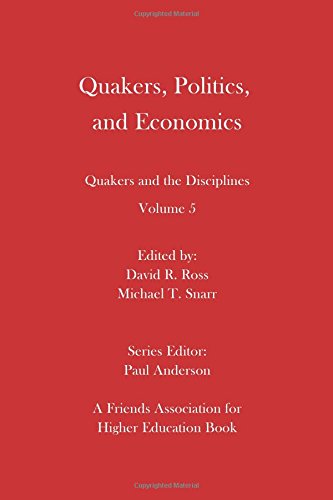
Our 2017 conference at Guilford College presented the disciplinary interest Quakers, Politics, and Economics, with editors David Ross and Michael Snarr. Chapters contributed by 20 Quaker scholars look at historical figures as well as current Quaker perspectives on contemporary economic issues.

In June, 2019, co-editors Cherice Bock and Stephen Potthoff were pleased to present Volume 6, entitled Quakers, Creation Care, and Sustainability. In this unprecedented gathering of essays on ecology, creation care, and sustainability, over two dozen Quaker authors and scholars address some of the most pressing concerns of our day. Beginning with Quaker themes historically, essays also move toward developing a Quaker ecotheology, discuss Quaker approaches to the environment within academic disciplines, and share stories of sustainability—both individually and organizationally. As a disciplinary contribution to the world from the Friends Association for Higher Education, this book not only reports on ecotheology in action, it also contributes to its furtherance with the discussion questions at the end of each section and an expansive bibliography. An excellent resource for study groups or the classroom, readers concerned about the environment, climate change, and the role of people of faith in caring for the planet will find this volume a must-read.
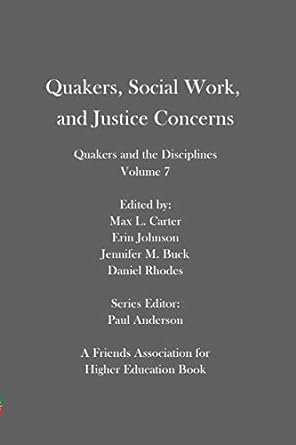
In Volume 7: Quakers, Social Work, and Justice Concerns, ten authors apply theory and history of Quaker work for social change in offering insight into how Friends have approached social work. The collection of essays is divided into three sections. The first considers theory of social work and change. A second section looks at individual Quakers’ lives and their work. The third section considers collective work of Friends in addressing social issues.

Volume 8: Quakers and the Future of Peacemaking offers a tribute to the life and work of Lonnie Valentine, whose gathering of these essays marks his culminative life-long contribution to the future of peacemaking from a Quaker perspective. After the introductory essays by Paul N. Anderson, Steve Angell and Colleen Wessel-McCoy, and George Lakey, essays in Part I by Doug Gwyn, Jennifer Buck, and Paul Anderson explore the origin and development of the Quaker Peace Testimony. Essays in Part II by Richard Miller, Mike Heller, Sherrema A. Oom-Dove, Cherice Bock, and Christine Ashley develop particular stories in the development of peacemaking issues among Friends over the years. Work accomplished and yet to be done is addressed meaningfully in this section. Part III includes essays on the theory and practice of peacemaking, and the contributions of Diana and John Lampen, Eric Ginsburg, Laura Rediehs, David Gross, Sue Williams, and Ron Mock further those concerns. Essays by Chuck Fager, Barbara Birch, Diane Randall, Gray Cox, Laura Rediehs, and Daniel Snyder in Part IV address the problems and promise of peacemaking in a number of meaningful ways; and in Part V, Daniel Hunter sketches reflections and prospects as we consider the future of peacemaking among friends, in addition to its present and past developments.
FAHE Book Committee invites book-subject topics for future editions, as we cover Quaker contributions across the disciplines. Potential contributors and editors, please contact the Book Committee.
 Friends Association for Higher Education